Home
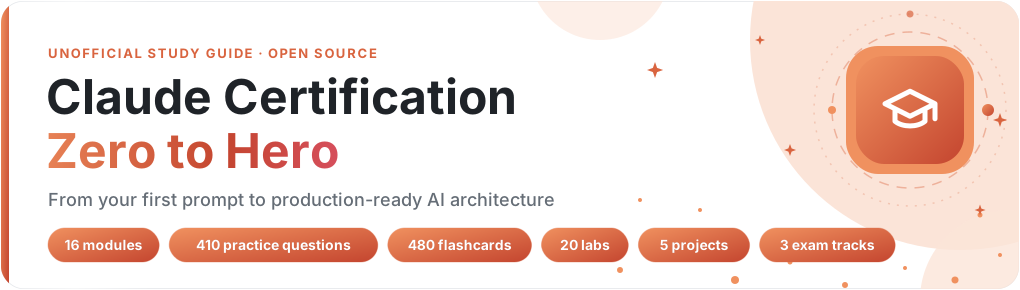
An open, original learning path that takes you from never having used Claude to preparing for Anthropic's certification exams, and to building secure, production-grade AI systems.






-
New to AI?
Start from zero: what LLMs are, how Claude works, and how to use this guide.
-
Business user: CCAO-F
Claude Certified Associate – Foundations, for people who use the Claude apps at work.
-
Builder: CCAR-F
Claude Certified Architect – Foundations: agents, the Agent SDK, Claude Code and MCP.
-
Architect: CCAR-P
Claude Certified Architect – Professional, for production and enterprise designs.
-
Practise now
Timed or learning-mode mock exams in your browser, with domain breakdowns.
-
Build something
Twenty hands-on labs that run free and offline, and five real-world projects.
Why this repository exists
Anthropic now runs a formal Claude Certification Program. The official exam guides list what is tested; they do not teach it. This repository fills that gap with:
- a zero-to-hero curriculum (16 modules) that assumes no prior AI knowledge,
- certification tracks that map every official exam objective to a lesson, a lab and practice questions,
- hands-on labs and projects that run free and offline by default,
- a dedicated AI security track for engineers who must ship safely,
- an offline mock-exam engine for independent practice.
It is also designed to be a practical reference long after the exam.
Who it's for
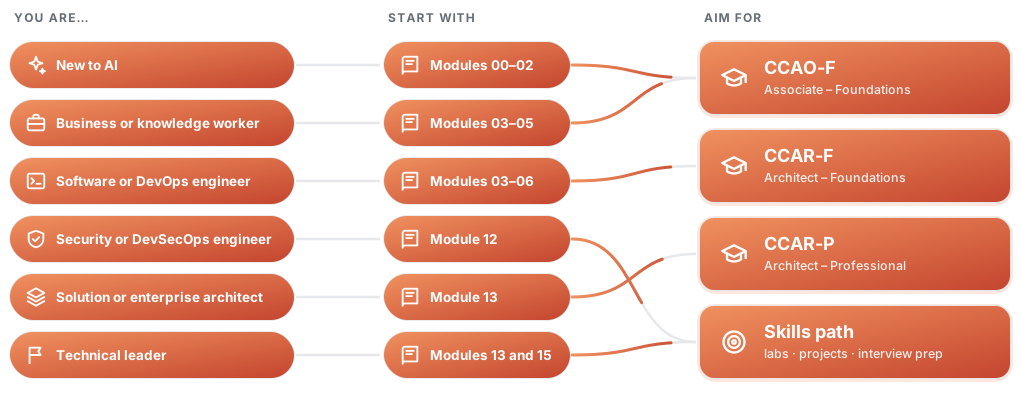
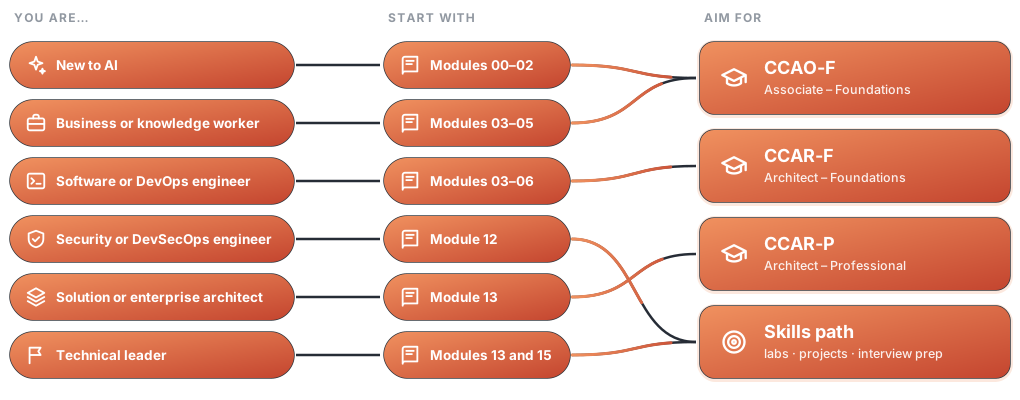
| You are… | Start here | Then |
|---|---|---|
| New to AI entirely | 00 Getting started → 01 AI & LLM fundamentals | The 30- or 60-day roadmap |
| A business or knowledge worker using Claude | 03 Prompt engineering → 05 Products & models | The CCAO-F track |
| A software, DevOps or cloud engineer | 03 Prompt engineering → 04 Context → 06 Claude API | Labs 07–12, then the CCAR-F track |
| A security or DevSecOps engineer | 12 AI security | Labs 13–15 and 18–20, projects 03–05 |
| A solution or enterprise architect | 13 Enterprise AI architecture | The CCAR-P track |
| A technical leader | 13 Architecture, 15 Production operations | Interview & stakeholder prep |
Not sure? Take the two-minute choose-your-path guide.
If this guide helps you, a ⭐ on GitHub helps other learners find it.
Certification tracks
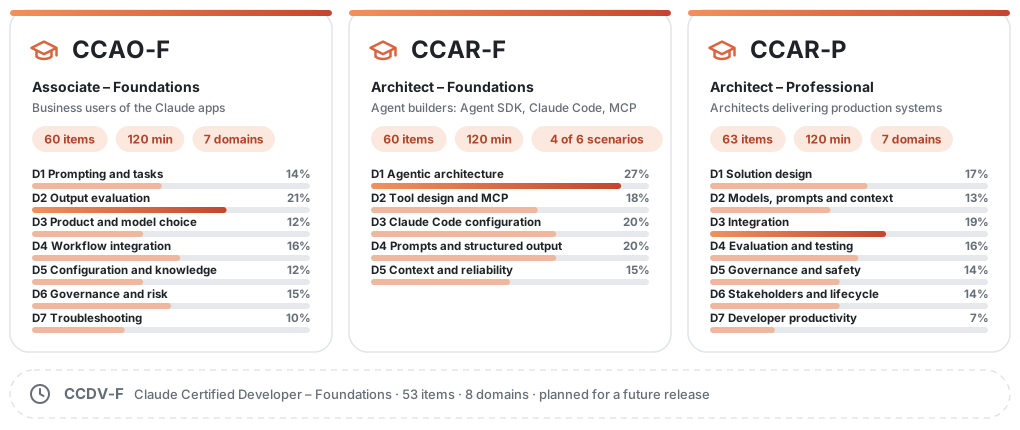
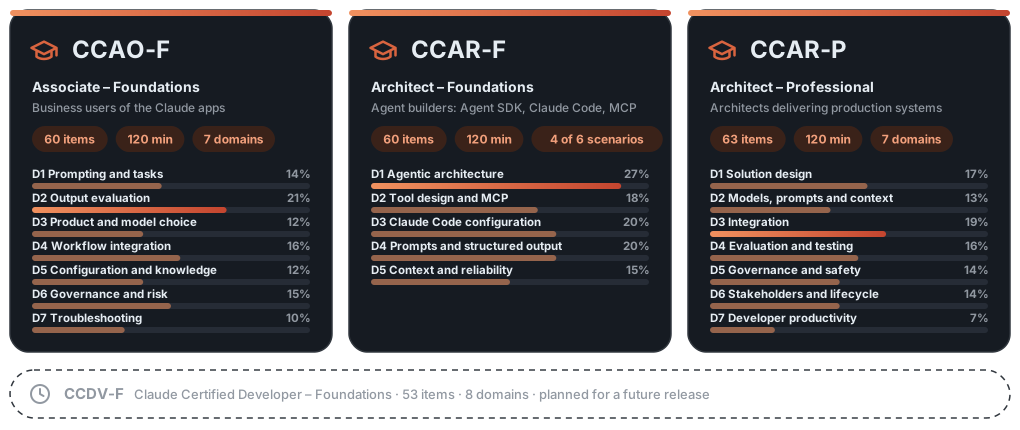
| Certification | Code | Audience | Track |
|---|---|---|---|
| Claude Certified Associate – Foundations | CCAO-F | Business users of the Claude apps | Full track |
| Claude Certified Architect – Professional | CCAR-P | Architects delivering production systems | Full track |
| Claude Certified Architect – Foundations | CCAR-F | Developers building agentic systems with the Agent SDK, Claude Code and MCP | Full track |
| Claude Certified Developer – Foundations | CCDV-F | Developers building on the API | Planned (roadmap) |
Who can take the exams: as of 2026-10-24, registration is open only to people at organisations in the Claude Partner Network (you register with a partner work email). Anyone can use this repository and Anthropic's free Claude Academy courses to learn; check eligibility before planning to sit an exam.
Exam formats, fees, eligibility and blueprints were verified against the official exam guides on 2026-10-24. See exam facts and the machine-readable registry. Anthropic plans updated guides on 2026-11-17.
The learning journey
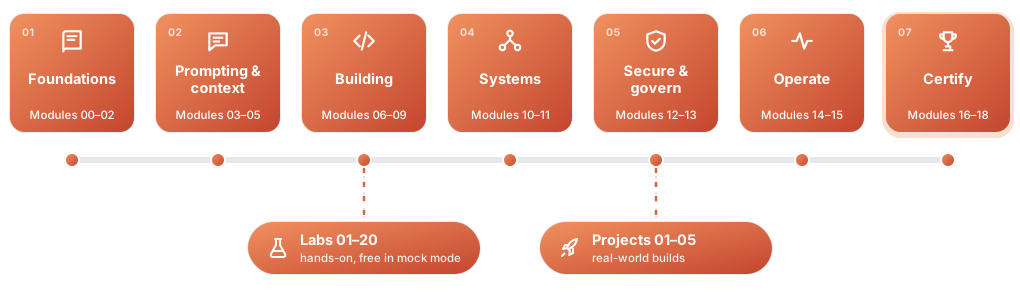
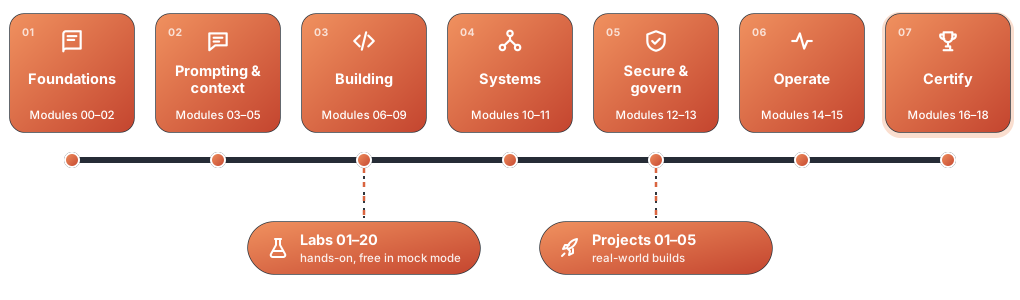
| Stage | Modules | You'll be able to… |
|---|---|---|
| 1. Foundations | 00 · 01 · 02 | Explain how LLMs work, what tokens and context windows are, and why hallucinations happen |
| 2. Prompting & context | 03 · 04 · 05 | Write reliable prompts, manage context and caching, choose the right model and product feature |
| 3. Building | 06 · 07 · 08 · 09 | Integrate the API, build tool-using apps, write MCP servers and roll out Claude Code |
| 4. Systems | 10 · 11 | Design workflows, agents, multi-agent systems and RAG pipelines |
| 5. Secure & govern | 12 · 13 | Threat-model LLM apps, defend against prompt injection and design compliant enterprise architectures |
| 6. Operate | 14 · 15 | Build evals, observe, optimise cost and latency, and run AI in production |
| 7. Certify | 16 · 17 · 18 | Prepare objective by objective and practise under exam conditions |
Study plans
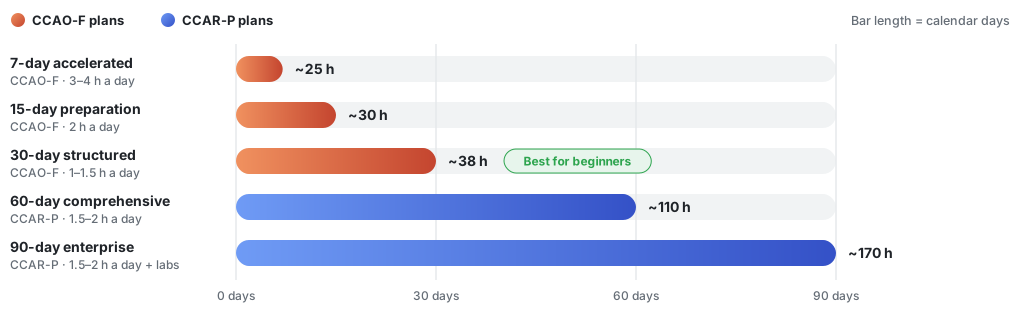
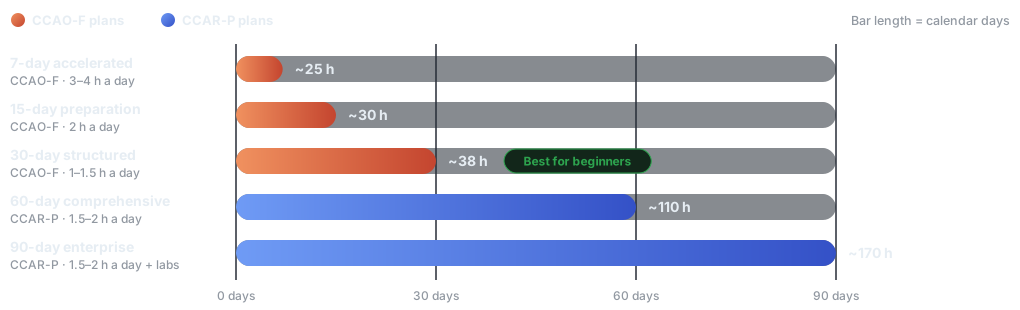
| Plan | Track | Assumes | Daily time | Link |
|---|---|---|---|---|
| 7-day accelerated | CCAO-F | Months of hands-on Claude use at work, including Projects | 3–4 h | 7-day |
| 15-day preparation | CCAO-F | Some hands-on use of Claude or a similar assistant; no coding | 2 h | 15-day |
| 30-day structured | CCAO-F | Nothing beyond basic computer use: best for complete beginners | 1–1.5 h | 30-day |
| 60-day comprehensive | CCAR-P | Several years of software or systems experience; reads Python | 1.5–2 h | 60-day |
| 90-day enterprise engineering | CCAR-P | Working developer, engineer or architect; no AI knowledge needed | 1.5–2 h + weekend labs | 90-day |
The roadmaps guide explains how to pick a plan. Anthropic publishes updated exam guides on 2026-11-17; plans will be refreshed after that (see exam facts).
Practise
python3 -m venv .venv && source .venv/bin/activate
pip install -r requirements-dev.txt

# Mock exams in the terminal (timed or learning mode)
python 18-mock-examinations/run_mock_exam.py --track CCAO-F --mode learn

# ...or in the browser
python3 -m http.server 8000     # then open http://localhost:8000/18-mock-examinations/web/

# Run a lab offline (no API key, no cost)
python 19-hands-on-labs/lab-01-first-claude-interaction/lab.py
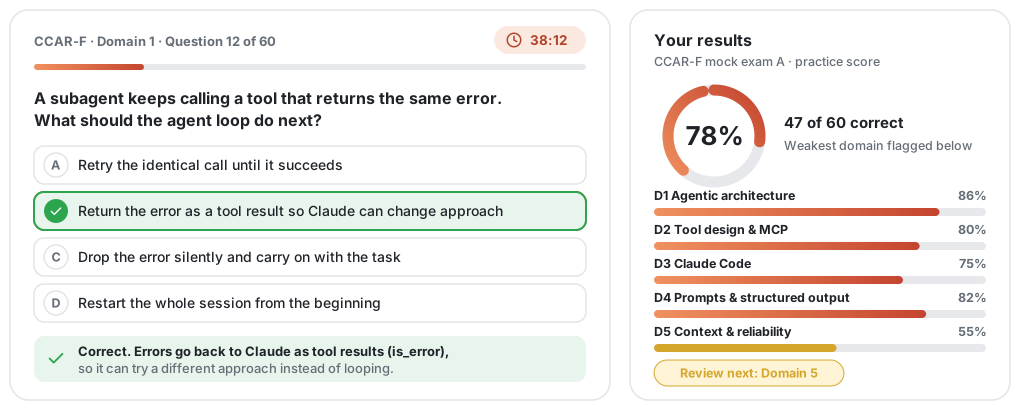
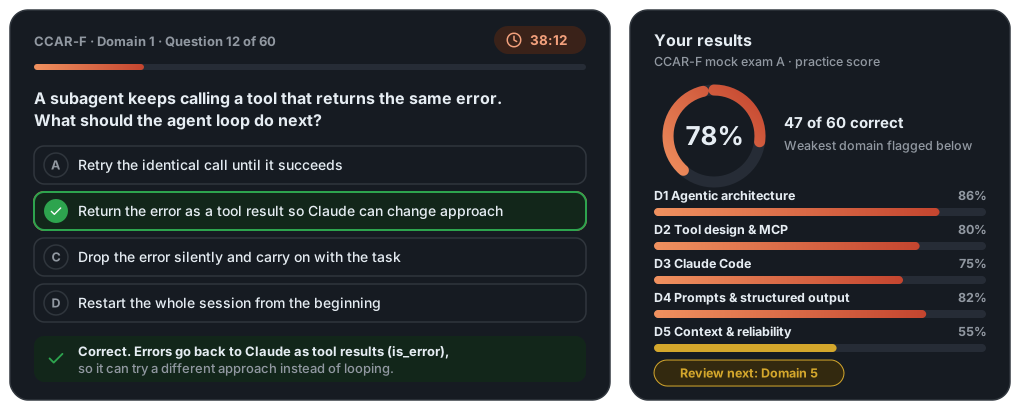
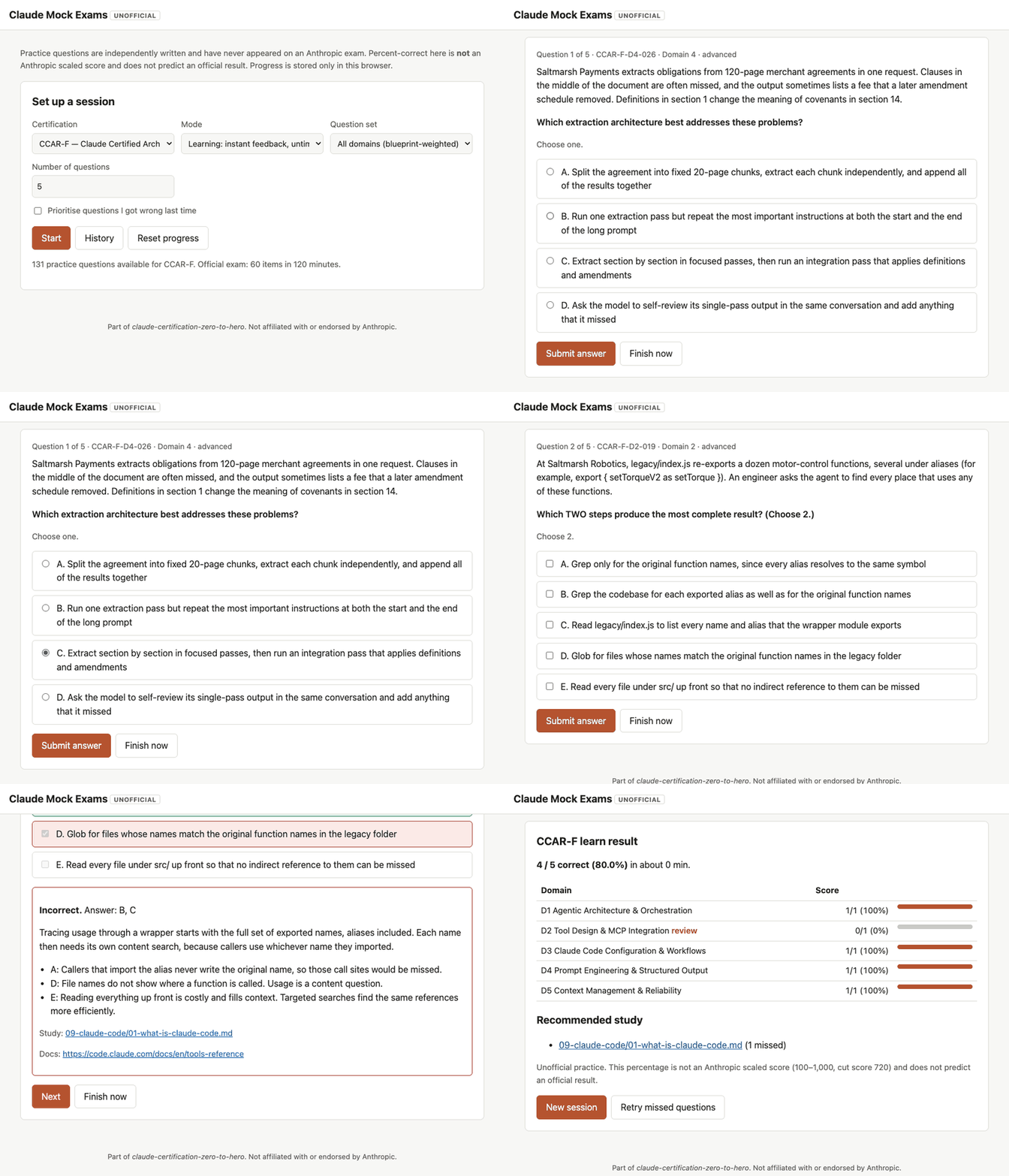
- Practice questions: unofficial, schema-validated, every distractor explained
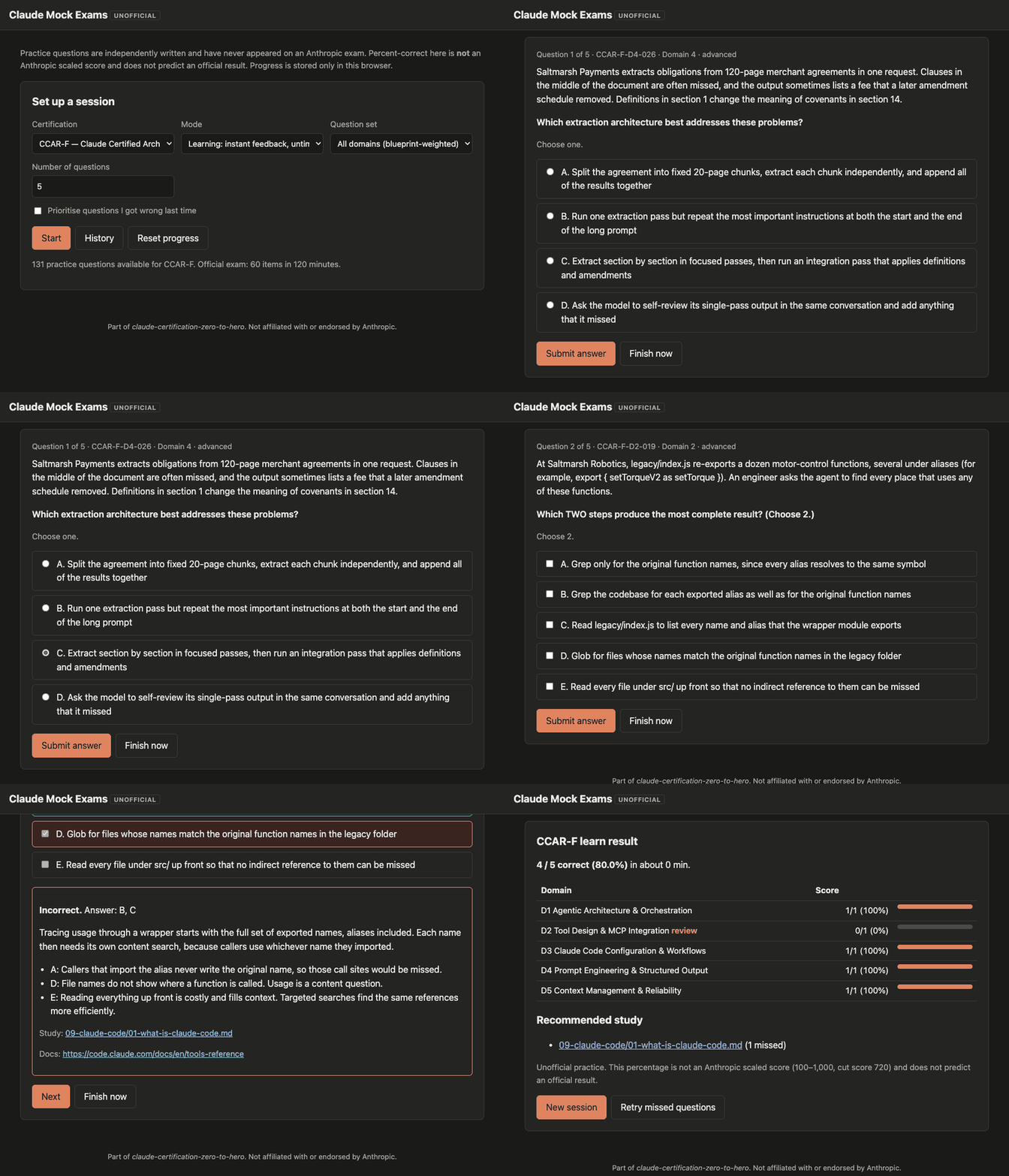
- Mock examinations: timed and learning modes, domain breakdowns, weak-area advice
- Flashcards: YAML decks, exportable to Anki
- Cheat sheets: one-page summaries for the API, prompting, Claude Code, MCP, security and each exam
The real practice app, recorded in learning mode (try it online):
Read it as a website
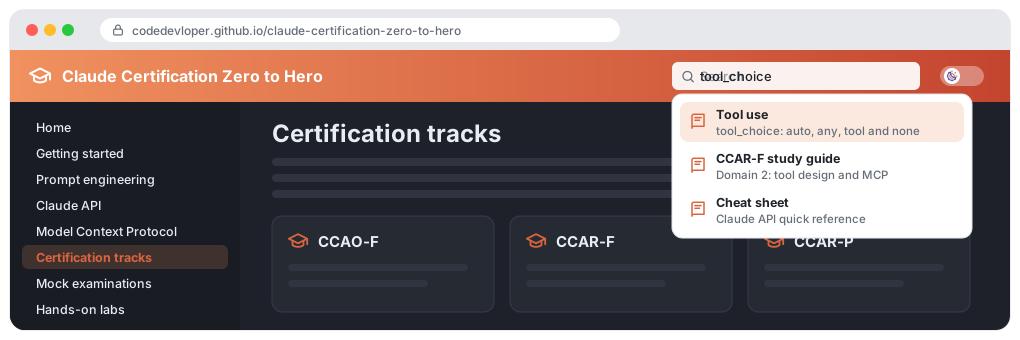
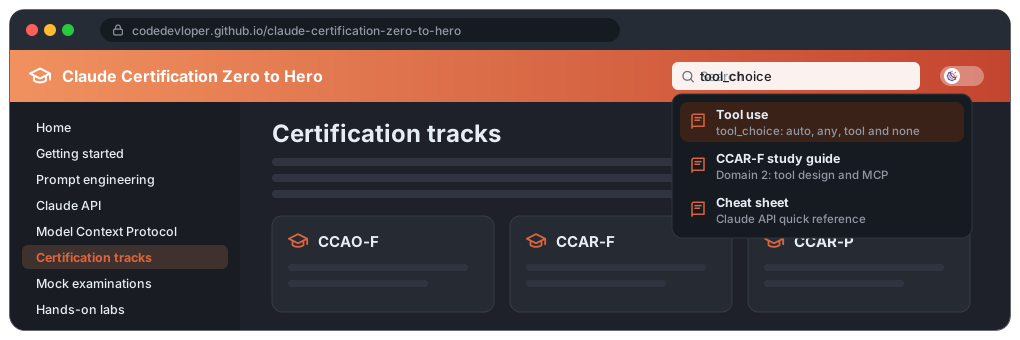
Everything here is also published as a searchable website with light and dark themes and the interactive practice
exam built in. The site is built from this repository with MkDocs and
Material for MkDocs, and deployed to GitHub Pages on every push to main
(see .github/workflows/pages.yml).
Preview it locally:
Hands-on
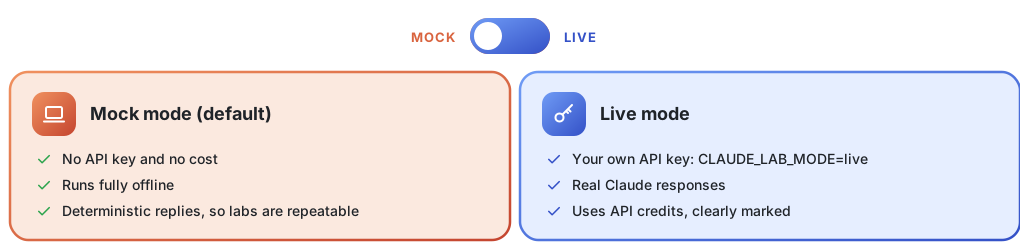
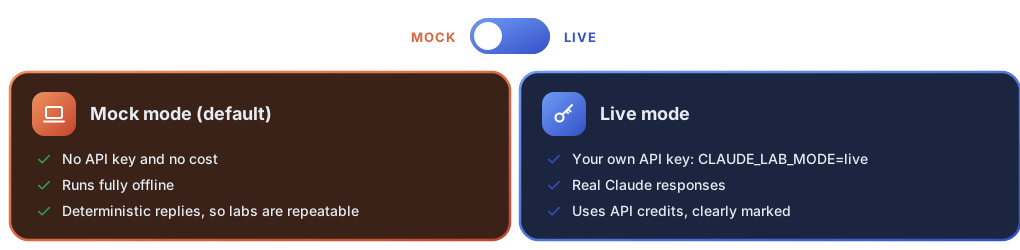
- 20 labs, from a first API call to a secure AI gateway. Every lab runs in free, offline mock mode, and in live mode with your own API key (clearly marked when it costs credits).
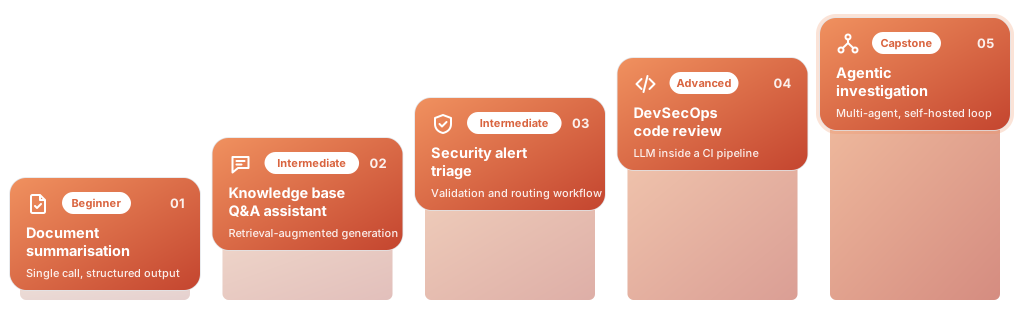
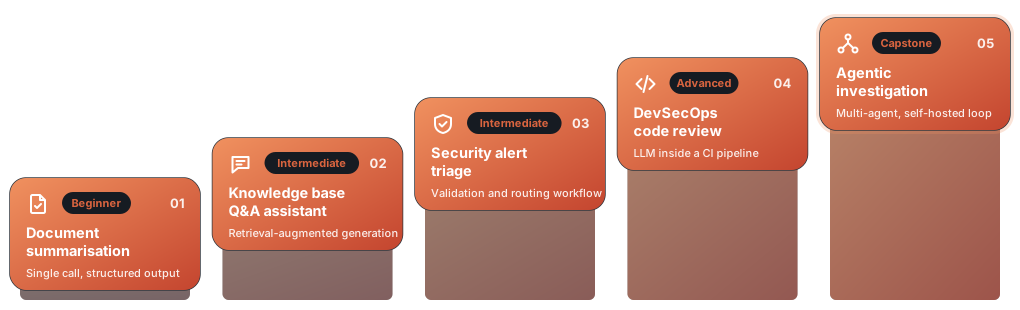
- 5 real-world projects of increasing difficulty: a document summariser, a knowledge-base Q&A assistant, a security alert triage assistant, a DevSecOps code-review assistant and an agentic investigation assistant. Each has requirements, an architecture, security design, tests and cost estimates.
Repository map
| # | Section | # | Section |
|---|---|---|---|
| 00 | Getting started | 13 | Enterprise AI architecture |
| 01 | AI & LLM fundamentals | 14 | Evaluation & testing |
| 02 | Claude fundamentals | 15 | Production operations |
| 03 | Prompt engineering | 16 | Certification tracks |
| 04 | Context engineering | 17 | Practice questions |
| 05 | Claude products & models | 18 | Mock examinations |
| 06 | Claude API | 19 | Hands-on labs |
| 07 | Tool use & function calling | 20 | Real-world projects |
| 08 | Model Context Protocol | 21 | Interview preparation |
| 09 | Claude Code | 22 | Cheat sheets |
| 10 | Agentic AI | 23 | Flashcards |
| 11 | RAG & knowledge systems | 24 | Troubleshooting |
| 12 | AI security | 25 | Official resources |
Also: Glossary · FAQ · Roadmap · Progress tracker · Changelog
Quality and integrity
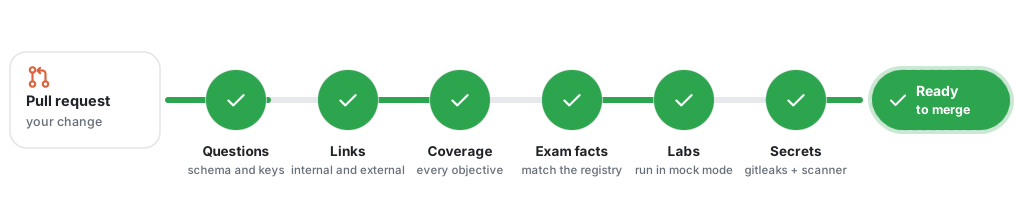
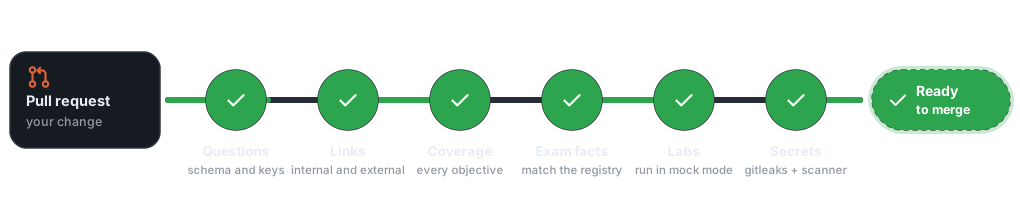
Every pull request is checked automatically:
- practice-question schema, unique IDs, answer keys and distractor rationales, plus near-duplicate detection,
- internal links and anchors, plus a weekly external link check,
- objective coverage (every official objective → module → lab → questions),
- exam facts consistent with the registry and linked to a source,
- all labs executed in mock mode, repository and project tests,
- secret scanning (gitleaks plus a local scanner) and markdown lint.
Run everything locally with python tools/validate_all.py --labs.
About the maintainer
This repository is maintained by Amol Bhure (@codedevloper).
I have been working with Claude for the last couple of years, alongside a range of other AI tools, including Microsoft Copilot, GitHub Copilot, ChatGPT, OpenAI Codex, Grok and Gemini. Using them side by side taught me that getting real value from AI depends less on which tool you pick and more on how well you prompt, check and design around it. That is what led me to pursue Anthropic's certifications, and I have been preparing for them since March 2026.
Earning these three Anthropic certifications between September and October 2026 was one of the most rewarding learning stretches of my career, and I am genuinely proud of it. Each exam pushed me past knowing what Claude can do and into judging how to use it well: when to trust an answer and when to check it, how to build security in from the start, and how to explain trade-offs to the people who depend on the system. Going from the Associate exam to the Architect Professional exam in a few weeks showed me how much there is to learn, and how much it pays off.
This repository is my way of paying that forward. It is the guide I wish I had had when I started. If it helps you pass an exam, or ship something you are proud of, it has done its job.
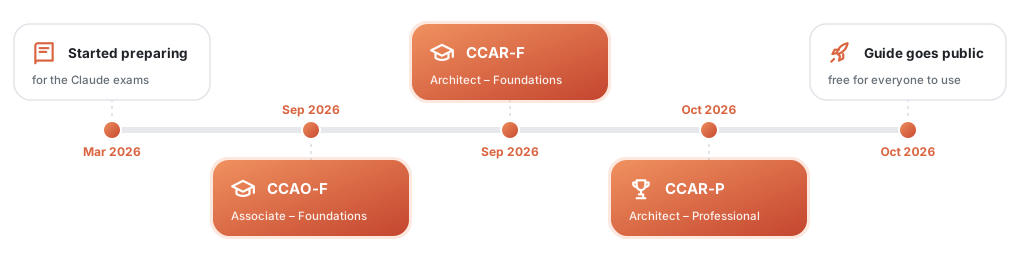
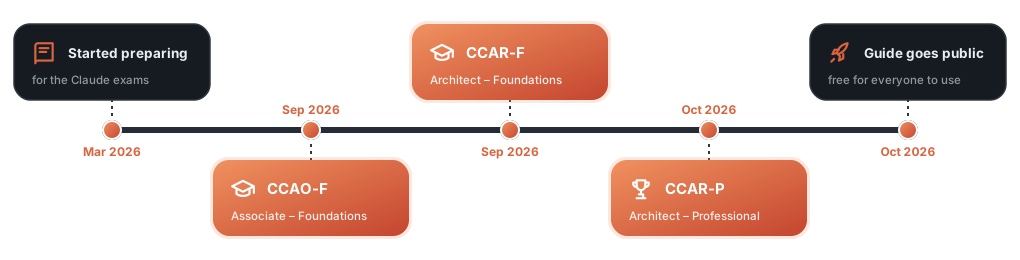
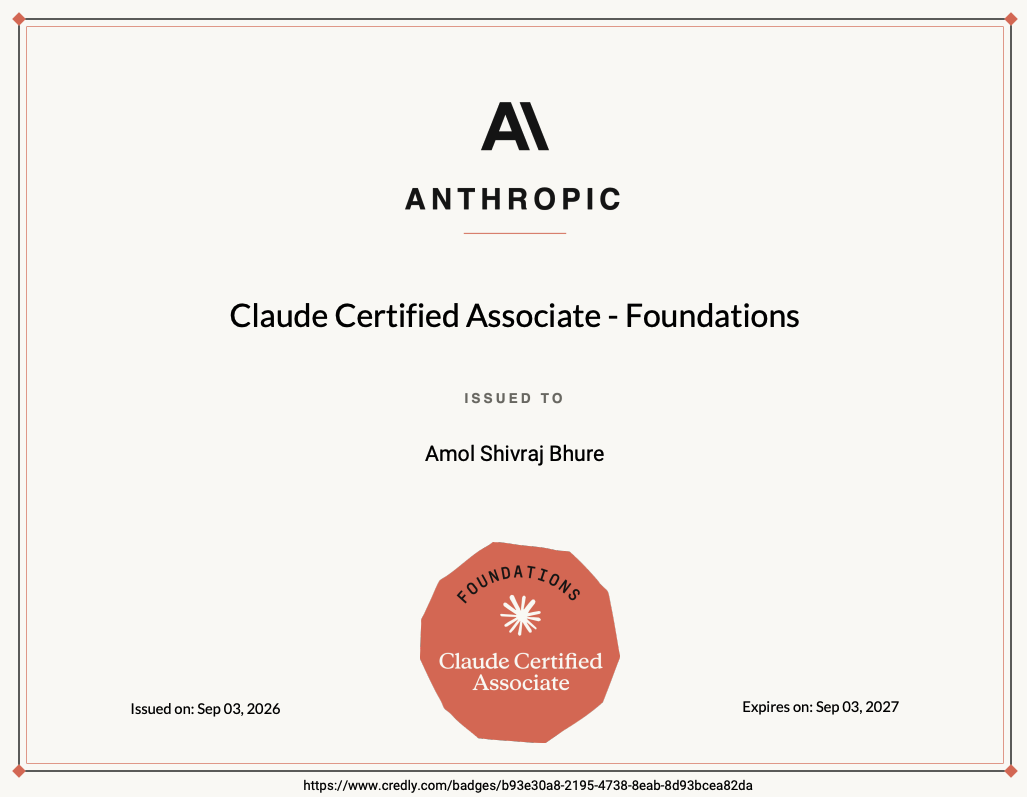
Claude Certified Associate – Foundations (CCAO-F) · earned Sep 2026 · Verify on Credly
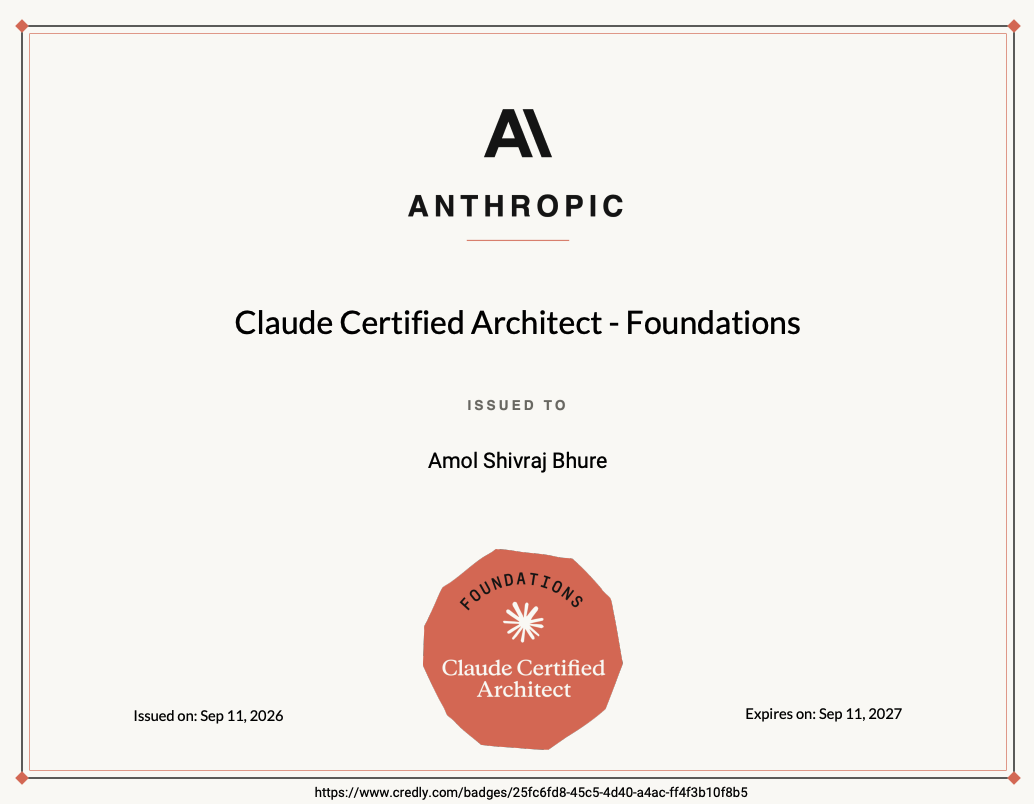
Claude Certified Architect – Foundations (CCAR-F) · earned Sep 2026 · Verify on Credly
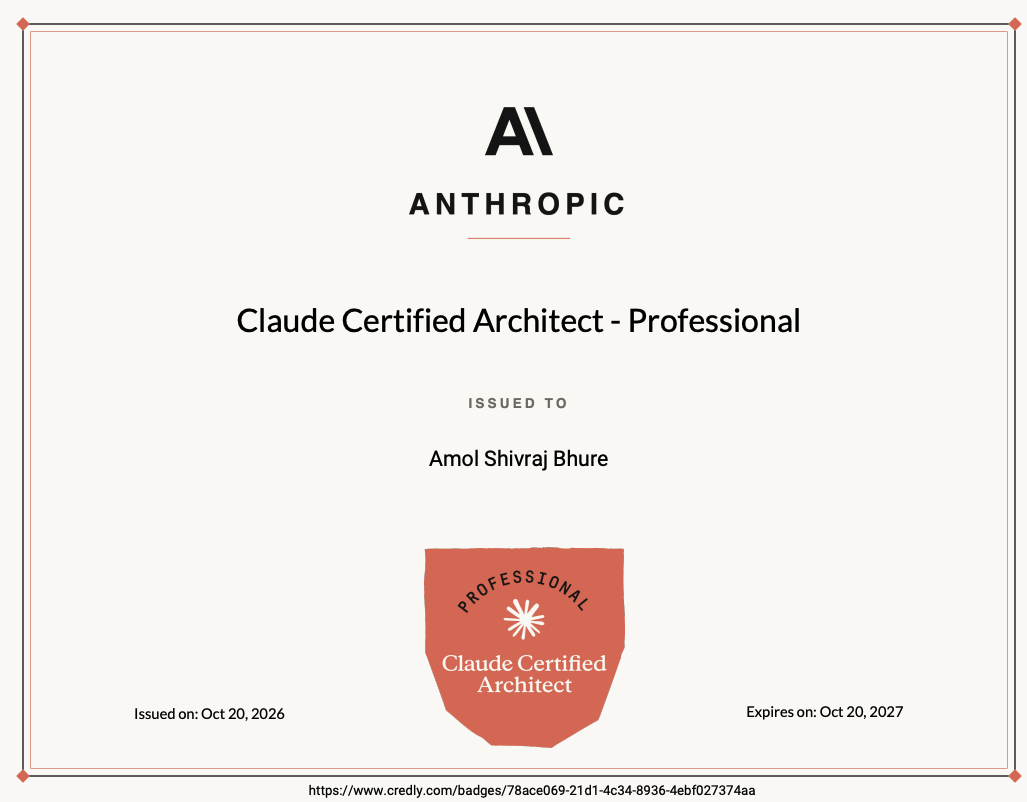
Claude Certified Architect – Professional (CCAR-P) · earned Oct 2026 · Verify on Credly
| Certification | Code | Earned | Valid until | Verify |
|---|---|---|---|---|
| Claude Certified Associate – Foundations | CCAO-F | Sep 2026 | Sep 2027 | Credly badge |
| Claude Certified Architect – Foundations | CCAR-F | Sep 2026 | Sep 2027 | Credly badge |
| Claude Certified Architect – Professional | CCAR-P | Oct 2026 | Oct 2027 | Credly badge |
Holding these certifications does not make this guide official, sponsored or endorsed by Anthropic. Exam content is confidential, and none of it is used here: everything in this repository is written from public documentation and the published exam guides.
Contributing


Contributions are welcome. Read CONTRIBUTING.md and the documentation standards. The two non-negotiables: original work only, and no real exam content, ever.
Official resources
Use these as your source of truth: the Anthropic Partner Academy certifications page (exam guides and policies), Pearson VUE (scheduling), Claude Academy (free courses), the Claude docs, Claude Code docs and modelcontextprotocol.io. More in 25 · Official resources.
Disclaimer
This is an independent, community study resource. It is not affiliated with, sponsored by or endorsed by Anthropic. "Claude", "Anthropic" and the certification names are trademarks of Anthropic, PBC, and are used here only to identify the products and exams this guide is about. Apart from the maintainer's own issued certificates shown in About the maintainer, which display Anthropic's logo and badge artwork as issued, the repository uses no Anthropic logos or artwork.
- The maintainer and contributors do not speak for Anthropic, and nothing here is official guidance or a promise about exam content or results.
- All practice and mock-exam questions are original and unofficial. None comes from, or is reconstructed from, a real exam. Mock-exam percentages are not Anthropic scaled scores and do not predict official results.
- Exam details can change. Always confirm with the official exam guide before you register or sit an exam.
- Product facts, model names and prices are dated where stated, and may have changed since.
- All organisations, people and data in examples are fictional. Several organisation names (such as Contoso, Fabrikam and Northwind) are fictional sample names popularised in Microsoft documentation; any resemblance to real organisations or people is coincidental.
- Third-party names (Amazon Bedrock, Google Cloud, Microsoft Foundry, OWASP, NIST and others) are trademarks of their owners and appear only for identification and reference.
Licence
Code is released under the MIT License and educational content under CC BY 4.0. The certificate images are excluded from both. See LICENSE-CONTENT.md for the details, attribution wording and trademark notices.